A non-spinning brush roll on your Shark Rotator NV650 is a common but usually fixable problem. The primary culprits are clogs from hair and debris, a snapped or worn drive belt, a tripped reset button, or a faulty motor. Most solutions involve simple inspection, cleaning, and part replacement that you can do at home with basic tools. Always unplug the vacuum first and consult your manual. With systematic troubleshooting, you can often restore full functionality without a costly service call.
You’re in the middle of vacuuming, and you notice it. That telltale sound is missing. The deep, carpet-shaking rumble that your Shark Rotator NV650 is famous for has been replaced by a weak, suction-only whine. You look down, and there it is: the iconic red brush roll is perfectly still. It’s not spinning. A wave of frustration hits. That powerful lift-away vacuum is now just a weak suction machine, pushing debris around instead of agitating and lifting it out. Before you panic and start searching for repair shops or a new vacuum, take a deep breath. A Shark Rotator Nv650 brush roll not working is one of the most common issues with this otherwise incredibly reliable machine, and the vast majority of the time, the solution is something you can handle yourself with a few simple tools and a bit of patience. This guide will walk you through every possible cause, from the quickest fix to the more involved repairs, so you can get your vacuum back to its formidable, debris-engulfing self.
Understanding why the brush roll stops is the first step. The Shark Rotator NV650’s brush roll is powered mechanically. An electric motor inside the motorized floor head spins a small drive pulley. A rubber belt loops around this pulley and the larger pulley on the end of the brush roll. When the motor runs, it turns the belt, which in turn spins the brush roll at high speed. Anything that interrupts this chain of motion—a blockage stopping the roll, a broken belt, a tripped safety switch, or a dead motor—will result in a stationary brush roll. Our job is to methodically check each link in that chain.
Key Takeaways
- Safety First: Always unplug your Shark Rotator NV650 from the wall outlet before inspecting or attempting any repair to prevent injury or damage.
- Clogs Are The #1 Suspect: Hair, string, and carpet fibers wrapping around the brush roll or blocking the suction pathway are the most frequent cause of a brush roll not working.
- The Drive Belt Is A Common Failure Point: This rubber belt connects the motor shaft to the brush roll. It can stretch, wear out, break, or slip off, stopping the roller entirely.
- Check The Reset Button: The Shark Rotator NV650 has a thermal reset button on the motorized floor head. If the motor overheated, this button may have tripped and needs to be pressed firmly.
- Motor Failure Is Rare But Possible: If the belt is intact and the reset is on, a burned-out motor is the last resort diagnosis, often requiring professional assessment or replacement.
- Prevention Is Key: Regular maintenance—cleaning the brush roll, checking the belt, and emptying the dust cup—prevents most brush roll issues and extends your vacuum’s life.
- Parts Are Available: Official Shark replacement belts (part # 1960F), brush rolls, and floor heads are readily available online, making DIY repairs economical.
📑 Table of Contents
Understanding Your Shark Rotator NV650’s Brush Roll System
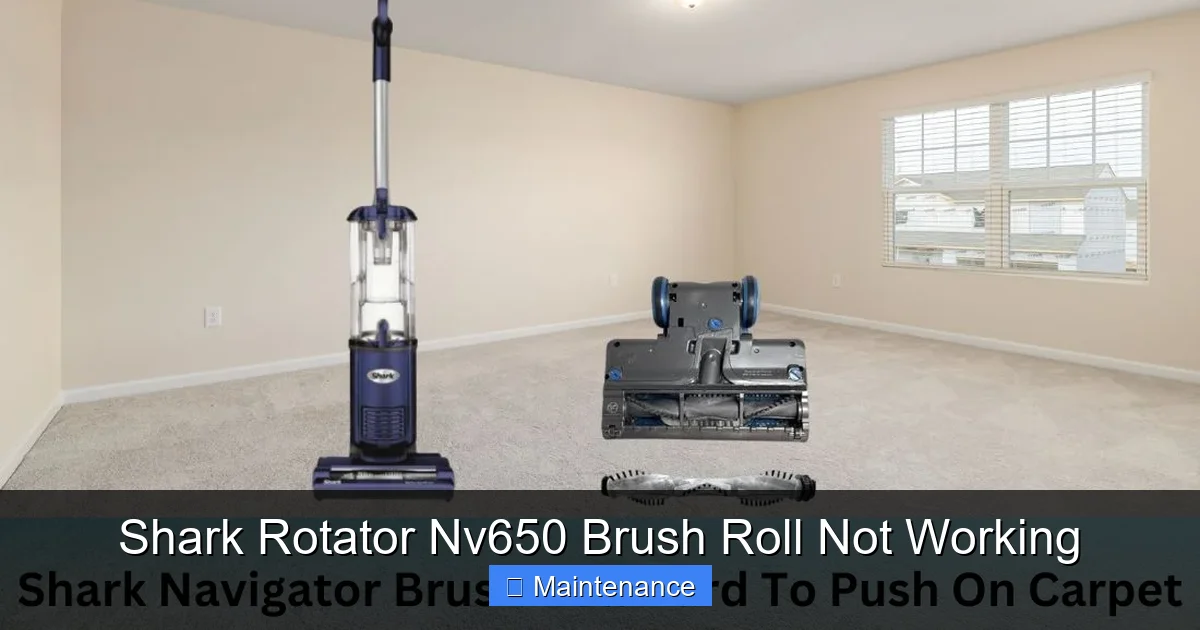
Before we start taking things apart, let’s get familiar with the components involved. Knowledge is power, and knowing what you’re looking at will save you time and confusion. The brush roll assembly itself is a long cylinder with bristles (or a combination of bristles and rubber fins on some models) that rotates. At each end, there’s a plastic cap with a bearing inside, allowing it to spin freely. One end connects directly to the drive belt. The other end often has a small gear or pulley that might be part of the belt drive system or a separate mechanism for the self-propelled feature on some models.
The drive belt is a critical, wear-prone part. It’s a specific, non-ribbed, round rubber belt designed for this model. It’s not a serpentine belt; it’s a simple loop. Over time, it can stretch, develop cracks, become glazed (shiny and slippery), or even snap completely. It sits inside a protective channel on the underside of the floor head. The motor itself is an electric unit housed within the body of the motorized floor head. It has a thermal safety fuse or reset button designed to cut power if the motor gets too hot, often from a jammed brush roll or clogged airways. Finally, there’s the electrical connection between the main vacuum body and the floor head. The Shark Rotator uses a metal contact system in the wand connection that delivers power to the floor head motor. Corrosion or damage here can also stop power flow.
The Role of Airflow and Suction
It’s crucial to understand that the brush roll’s motion and the vacuum’s suction are separate but related systems. You can have perfect suction with a dead brush roll (a clogged hose or full dust cup affects suction, but not the belt-driven brush roll). Conversely, a jammed brush roll that the motor can’t turn can cause the motor to overheat and shut off, which might also slightly reduce suction as a side effect. Your first diagnostic clue is: does the vacuum have strong suction? If suction is strong, the problem is isolated to the brush roll drive system. If suction is weak, you likely have a clog *and* a brush roll issue, or the motor has shut down due to overheating from a jam.
Immediate Troubleshooting: The 5-Minute Inspection
Before you grab a screwdriver, let’s perform the fastest, easiest checks that solve 70% of all Shark Rotator Nv650 brush roll not working complaints. These steps require no disassembly.
Visual guide about Shark Rotator Nv650 Brush Roll Not Working
Image source: sharkvacuum.blog
Step 1: The Visual & Physical Check
Flip your Shark Rotator NV650 over. Look directly at the brush roll through the opening on the underside of the floor head. Is it visibly jammed with hair, carpet fibers, or a sock? Use a flashlight. Often, you’ll see a thick mat of material wrapped around the axle or binding between the bristles. If you see this, you’ve found your problem. Use a seam ripper, a pair of scissors, or even a sturdy butter knife (carefully!) to cut and pull away the debris. You may need to rotate the brush roll by hand (unplugged!) to access all sides. Clear it until it spins freely when you turn it manually.
Step 2: The Reset Button Hunt
Locate the small, circular, red reset button. On the NV650, it’s typically on the back or side of the motorized floor head housing, near where the wand connects. It’s often recessed. With the vacuum unplugged, press this button firmly with a pen or screwdriver until you feel it click. This resets the thermal fuse that may have tripped if the motor overheated from a previous jam. This is the single most common fix and takes 10 seconds. Always try this after clearing any visible jam.
Step 3: Belt Access & Quick Look
Lay the vacuum on its side. On the underside of the motorized floor head, you’ll see a large rectangular access panel held by several (usually 4-6) screws. This is the belt cover. Using the appropriate screwdriver (often a Phillips #2), remove these screws and set them aside. Gently pry off the plastic cover. Look inside. Can you see the rubber belt? Is it hanging loose, broken, or missing entirely? If it’s clearly snapped or gone, you’ve identified the issue. If it’s there but looks loose, slippery, or out of position on the pulleys, that’s your culprit. Even if it looks okay, a worn belt can slip under load. A quick visual here is very telling.
Step 4: Check for Suction Loss
Now, turn the vacuum on (with the brush roll area clear). Put your hand over the floor head’s suction opening. Do you feel strong suction? If suction is weak or absent, you have a clog somewhere in the system—the hose, wand, or dust cup. A severe clog can sometimes put back pressure on the motor and affect the brush roll, but typically, a clog affects suction first. You must clear the clog before diagnosing the brush roll properly. Empty the dust cup completely, check the pre-motor and post-motor filters (wash them if dirty), and inspect the hose for blockages.
Deep Dive: Common Causes & Detailed Fixes
If the quick inspection didn’t solve your Shark Rotator Nv650 brush roll not working dilemma, it’s time for a deeper investigation. We’ll move from the most likely to the least likely causes.
The Drive Belt: Diagnosis and Replacement
If you removed the belt cover in Step 3 and the belt is missing, broken, or visibly worn, replacement is needed. This is a very common and inexpensive fix. The official Shark replacement belt part number is 1960F (or sometimes listed as NV650 belt). You can find it on Amazon, Shark’s website, or appliance part stores.
How to Replace the Belt:
- With the belt cover already off, locate the brush roll. You’ll see it seated in the floor head housing, with the belt (if present) looped around the motor pulley and the brush roll pulley.
- To remove the old belt, simply stretch it off the motor pulley first, then slide it off the brush roll pulley.
- Take your new belt. Stretch it over the brush roll pulley first. It should fit snugly. Then, stretch the other side over the smaller motor pulley. You will need to manually rotate the brush roll slightly to help the belt seat properly on both pulleys. It can be tight—that’s normal.
- Before reinstalling the belt cover, manually rotate the brush roll several full turns by hand. It should spin smoothly and the belt should track correctly without slipping off.
- Reinstall the belt cover and screws securely.
- Reassemble the vacuum, plug it in, and test. The brush roll should now spin vigorously.
Pro Tip: While you have the belt cover off, this is the perfect time to remove the brush roll itself for a thorough cleaning. Pull the brush roll straight out. You’ll likely find a ton of hair wound around the axles and inside the end caps. Use scissors to cut it away. Clean the bearings if possible. A clean, free-spinning brush roll puts less strain on the new belt and motor.
Brush Roll Bearing or Axle Jam
Sometimes, the brush roll itself is the problem. Hair and grime can work their way into the plastic end caps and jam the metal axle inside its bearing. Even if the belt is fine, a brush roll that can’t spin freely will stall the motor (causing overheating) or simply not move.
How to Fix:
- Remove the brush roll as described above.
- Inspect both plastic end caps. Look for any hair or debris packed around the axle where it enters the cap. Pull it out with tweezers.
- Try to spin each end cap by hand relative to the brush roll body. It should rotate smoothly. If it’s gritty or stuck, the bearing inside is contaminated.
- You can try to clean it out with compressed air or a cotton swab dipped in rubbing alcohol. However, if it’s severely jammed, the entire brush roll assembly (part # 1961F for NV650) is relatively inexpensive to replace as a unit. It’s often easier than trying to refurbish the old one.
- Also, inspect the brush roll itself for any bent or broken bristles that could be catching on the floor. Replace the roll if it’s damaged.
Electrical Issues: Wand Connection & Motor
If you have a new belt, a clean, free-spinning brush roll, you’ve reset the button, and it still doesn’t work, the issue is likely electrical.
The Wand Connection: The Shark Rotator’s power flows from the main body, through the wand, and into the floor head via two metal contact points. Unplug the vacuum. Detach the wand from the floor head. Look inside the connection port on the floor head. You should see two small metal pins or strips. Are they clean? Are they bent or broken? Similarly, look at the corresponding connectors on the wand. Clean any oxidation or debris with a pencil eraser or contact cleaner. Gently bend any bent pins back into position. A poor connection here means no power to the motor.
The Motor Itself: This is the most serious and least common failure. If the motor has burned out, it will not hum or attempt to start. You might smell a burnt odor. Diagnosing a dead motor definitively requires a multimeter to test for continuity, which is an advanced repair. For most users, if you’ve ruled out the belt, brush roll jam, reset button, and electrical connectors, the motor is the likely failed part. Replacing the motor in the floor head is a complex disassembly and is often best left to a professional appliance repair technician unless you are very handy. The cost of a new motor plus labor can sometimes approach the cost of a new floor head, so weigh your options.
Advanced Repairs & Part Replacement
Let’s say you’ve confirmed the belt is broken and you’ve replaced it, but the new belt immediately breaks or slips, or the brush roll still doesn’t spin. This points to a deeper issue.
Visual guide about Shark Rotator Nv650 Brush Roll Not Working
Image source: sharkvacuum.blog
Motor Pulley Problems
The motor has a small plastic pulley attached to its shaft. This pulley can crack, become loose, or break off. If it’s not there or is wobbly, the belt has nothing to grip. Inspect this pulley closely after removing the belt cover. If it’s damaged, the motor assembly likely needs to be replaced. This is another job for a pro or a very confident DIYer, as it involves disassembling the motor housing.
Brush Roll Pulley/Gear Issues
The end of the brush roll that the belt rides on has a built-in pulley or gear. If this plastic piece cracks or breaks off the metal axle, the belt will fly off or have no purchase. Inspect the brush roll ends carefully. If the pulley is broken, you must replace the entire brush roll assembly, as it’s not a separate part.
Self-Propelled Mechanism (If Applicated)
Some Shark Rotator NV650 models have a self-propelled drive wheel. This is a separate system from the brush roll belt, though they share the same motor sometimes. If your model has this feature and it’s not working *along with* the brush roll, it could be a separate belt or gear issue. Consult your specific model’s manual for the self-propelled drive system diagnosis. However, a failure in this system usually doesn’t stop the brush roll itself from spinning unless it’s a shared motor that has been overloaded.
Preventive Maintenance: Keeping the Brush Roll Spinning
An ounce of prevention is worth a pound of cure. A few minutes of regular maintenance will drastically reduce the chances of ever facing a Shark Rotator Nv650 brush roll not working situation again.
After Every Use: Quick Wins
- Empty the Dust Cup: Don’t let it get completely full. A full cup restricts airflow.
- Check the Brush Roll: Before you store the vacuum, flip it over and glance at the brush roll. If you see hair starting to wrap, cut it off now before it becomes a solid mat.
- Wipe the Connections: Give the wand-to-floor-head connection a quick wipe with a dry cloth to keep the electrical contacts clean.
Weekly/Monthly Deep Clean
- Remove and Clean the Brush Roll: Once a month, take the brush roll out completely. Use scissors to cut away any hair wrapped around the axles. Wash the bristles with warm, soapy water if they’re very dirty with grime (let them dry completely for 24 hours before reinstalling).
- Inspect the Belt: While the brush roll is out, look at the belt. Check for cracks, glazing, or stretching. A belt in good condition should be flexible and have a matte finish. Replace it every 6-12 months as a preventive measure, especially if you have pets or thick carpet.
- Clean Filters: Wash the pre-motor foam filter and the post-motor pleated filter as per your manual’s instructions. Let them dry fully.
- Clear Air Pathways: Check the hose, wand, and all connectors for any small blockages. Use a long coat hanger or a flexible brush to dislodge debris.
For Pet Owners & Thick Carpet Homes
If you have dogs or cats that shed, or if you have deep-pile rugs, you are in the high-risk category for brush roll jams. Consider these extra steps:
- Use the “Bare Floor” setting (which turns off the brush roll) on area rugs that are delicate or prone to fraying. This reduces fiber ingestion.
- Invest in a small, dedicated “seam ripper” tool. It’s the absolute best tool for slicing through wrapped hair without damaging the brush roll bristles.
- Be more vigilant with the post-vacuum brush roll check. Hair wraps can happen in a single use on a heavy-shedding pet.
When to Seek Professional Help or Consider Replacement
You’ve followed this guide. You’ve replaced the belt, cleaned the brush roll, checked connections, reset the button, and cleaned every filter. The vacuum has strong suction, but the brush roll remains stubbornly still. Now what?
Diagnosing a Failed Motor
At this point, a failed motor is the most probable cause. Diagnosing this requires testing the motor for continuity with a multimeter, which involves accessing the motor’s wiring terminals. If you are not comfortable with this, it’s time to call a pro. A reputable appliance repair shop can confirm the motor failure for a diagnostic fee. Given the age and value of your Shark Rotator NV650, you need to do a cost-benefit analysis.
Cost-Benefit Analysis: Repair vs. Replace
- Cost of Repair: A new motor for the NV650 floor head can cost $70-$120 for the part alone. Professional labor adds another $80-$150. Total repair could be $150-$270.
- Cost of a New Floor Head: You can often purchase a brand new, complete motorized floor head for the NV650 for $180-$250. This gives you a fully warrantied unit.
- Cost of a New Vacuum: A new Shark Rotator NV650 or its current equivalent might be on sale for $250-$350.
The Logic: If your vacuum is older than 5-7 years and has had other issues, investing in a new machine might be smarter. If it’s only 2-3 years old and you’ve loved its performance, replacing the floor head is an excellent choice—it’s like giving your vacuum a new heart. It’s often more economical than repairing the motor in the old head.
Warranty Check
Before you spend any money, check your warranty. The Shark Rotator NV650 typically came with a 5-year limited warranty upon original purchase (you must have registered it). If your vacuum is still within that window and the issue is a manufacturing defect (like a motor that failed prematurely), Shark may repair or replace it for free. Contact Shark Customer Support with your serial number and proof of purchase.
Frequently Asked Questions
My Shark Rotator NV650 brush roll spins but the vacuum has no suction. Is this related?
No, these are usually separate issues. A spinning brush roll with no suction points to a severe clog in the hose, wand, or dust cup, or a full/blocked dust cup. Empty the cup completely, check all hose connections, and inspect the filters. A clogged post-motor filter is a very common cause of total suction loss.
I replaced the belt, but it immediately slips or breaks again. Why?
This usually indicates one of three problems: 1) The brush roll bearings are seized, causing excessive drag on the belt. Remove the brush roll and ensure it spins freely by hand. 2) The motor pulley is worn, smooth, or damaged, providing no grip for the belt. 3) You installed the wrong belt model. Ensure you are using the official Shark 1960F belt for the NV650.
Is it safe to use the vacuum with the brush roll belt removed?
You can use the vacuum in “suction-only” mode (on hard floors) with the belt off, but it is not recommended for regular use. Without the belt, the brush roll is stationary and can still pick up debris, but you lose the agitating action crucial for deep carpet cleaning. More importantly, running the motor with no belt load can cause it to overspeed and potentially damage the motor or create a safety hazard. Always reinstall the belt before using on carpet.
What does a broken motor sound like?
A failed motor often produces no sound at all—no hum, no whir. It’s completely dead. Sometimes, a dying motor will make a high-pitched whining or grinding noise before it fails completely. If you hear a grinding noise, it could also indicate something is jammed in the brush roll or a bearing is shot. A burnt electrical smell is a dead giveaway of motor failure.
Can I use a third-party or generic belt instead of the Shark 1960F?
While generic belts are cheaper, they are often made of inferior rubber that stretches quickly, becomes glazed, and slips. The official Shark belt is engineered for the specific torque and speed of the NV650 motor. Using a generic belt often leads to premature failure and can cause you to repeatedly troubleshoot a Shark Rotator Nv650 brush roll not working problem that comes back quickly. It’s generally worth the small extra cost for the OEM part.
My vacuum is less than a year old and the brush roll stopped. Is this normal?
No, it is not normal for a new or nearly new vacuum. This suggests a potential manufacturing defect, most commonly in the belt (a bad batch) or, more seriously, the motor. You should immediately contact Shark Customer Support. Do not attempt repairs yourself if the unit is under warranty, as opening it may void the warranty. They will guide you through their warranty replacement or repair process.