The Cub Cadet RZT 50 is a powerful zero-turn mower, but like any machine, it develops issues over time. Common Cub Cadet RZT 50 problems typically involve the engine (hard starts, loss of power), the cutting deck (uneven cuts, vibration), and the hydrostatic transmission (weak performance, leaks). Many of these issues stem from routine wear, poor maintenance, or failed components like belts, filters, and spark plugs. This guide breaks down each problem area, offering clear diagnostic steps and practical repair advice to help you diagnose and fix your mower yourself, saving significant service costs.
Key Takeaways
- Preventive Maintenance is Non-Negotiable: The vast majority of Cub Cadet RZT 50 problems are directly linked to skipped oil changes, dirty air filters, old fuel, and neglected deck cleaning. A strict seasonal maintenance schedule is your first and best defense.
- Fuel System Issues Are Prime Suspects: Modern ethanol-blended fuels degrade quickly, causing varnish and gumming. Stale fuel, clogged fuel filters, and faulty fuel pumps are leading causes of hard starting and sputtering engines.
- The Deck Demands Respect: A dull, damaged, or improperly balanced blade will cause a poor cut, excessive vibration, and strain on the entire mower. Regular blade inspection, sharpening, and deck cleaning are critical for performance and safety.
- Hydrostatic Transmissions Are Sensitive: While robust, these systems require the correct oil type and level. Low oil, contaminated fluid, or internal wear will lead to sluggish response, overheating, and eventual failure. Never ignore transmission whines or leaks.
- Electrical Problems Are Often Simple: Many “electrical” faults—no-start, weak electric clutch—trace back to corroded battery terminals, a weak battery, or blown fuses. Always check the simplest connections first before replacing expensive parts.
- Know When to Call a Pro: While many Cub Cadet RZT 50 problems are DIY-friendly, major transmission rebuilds, engine internal repairs, or complex electrical diagnostics often require specialized tools and expertise. Forcing these repairs can cause catastrophic damage.
- Use Genuine or OEM-Equivalent Parts: Off-brand belts, filters, and blades often fail prematurely, cause poor performance, and can damage other components. Investing in quality parts ensures compatibility and longevity, preventing repeat problems.
📑 Table of Contents
- Introduction: Your Trusted Mower Needs Your Help
- Engine Gremlins: Starting, Running, and Power Loss
- Cutting Deck Catastrophes: Uneven Cuts and Violent Vibration
- Transmission Troubles: The Hydrostatic Heart
- Electrical Enigmas: From Clutch to Charge
- Steering and Mobility: Handling and Maneuverability
- Conclusion: Empowered Ownership Through Knowledge
Introduction: Your Trusted Mower Needs Your Help
You bought your Cub Cadet RZT 50 for its reputation—solid power, a smooth zero-turn radius, and the promise of a perfectly manicured lawn with less effort. It’s a workhorse. But even the best workhorses need regular care and occasional troubleshooting. When your RZT 50 sputters, cuts poorly, or won’t move like it used to, frustration sets in. The good news? Many common Cub Cadet RZT 50 problems are not only diagnosable by the average homeowner but are often fixable with some basic tools, patience, and the right knowledge. This guide is your comprehensive manual to understanding what’s ailing your mower. We’ll move beyond the frustration and into practical, step-by-step solutions for the most frequently reported issues, from a cranky engine to a vibrating deck. Think of this as your conversation with a seasoned small engine mechanic, right in your garage.
Engine Gremlins: Starting, Running, and Power Loss
The heart of your RZT 50 is its engine, typically a robust Kohler or Kawasaki. When the heart stutters, the whole machine suffers. Engine-related Cub Cadet RZT 50 problems are the most common complaints, and they usually fall into a few predictable categories.

Visual guide about Cub Cadet Rzt 50 Problems
Image source: mowing.expert
The Dreaded Hard Start or No-Start
You turn the key and hear… nothing. Or a slow crank. Or it cranks but won’t fire. Before you panic about a dead engine, run through this checklist. First, check the battery. Corroded terminals or a weak battery are the #1 cause of no-crank conditions. Clean the terminals with a baking soda/water mix and a wire brush, then try again. If it cranks slowly, the battery may need a charge or replacement. Second, verify your safety interlocks. The RZT 50 has seat switches and brake/parking brake switches. If you’re not seated properly or the brake isn’t disengaged fully, the engine won’t start. Listen for a faint click from the starter solenoid; if you hear it but the starter doesn’t engage, the starter itself may be faulty.
If it cranks normally but won’t fire, fuel is your next suspect. Did you run the tank dry last season? Old, degraded fuel (more than 30 days old with ethanol) can clog the carburetor jets. Drain the old fuel and refill with fresh, non-ethanol gas if possible. If you stored it with fuel, add a stabilizer like Sta-Bil. Next, inspect the spark plug. Remove it, check for a cracked insulator, excessive carbon buildup, or a wide gap. A fouled plug from oil or fuel will prevent ignition. Clean it with a wire brush or, better yet, install a new, gapped plug (typically 0.030″ for many models). Finally, ensure the air filter isn’t clogged with debris. A starved engine can’t start. A quick tap to dislodge dust is a temporary fix; a deep clean or replacement is the proper solution.
Rough Running, Sputtering, and Loss of Power
Your mower starts but runs rough, surges, or lacks the power to cut thick grass. This is often a fuel delivery or air filtration problem. A clogged fuel filter is a frequent culprit. These small, inline filters are designed to catch debris but will restrict flow if neglected. Locate it in the fuel line (consult your manual) and replace it annually. Similarly, a dirty carburetor is a classic issue. Ethanol leaves gummy residues that clog tiny passages. You can try a carburetor cleaner spray through the air filter intake while the engine runs, but for persistent problems, a thorough soak or rebuild kit is necessary.
Don’t overlook the muffler. A plugged or carbon-clogged muffler can create backpressure, choking the engine. If you can easily remove it, check for obstructions. Also, inspect the governor linkage. This mechanical system controls throttle response. If the linkage is sticky, disconnected, or the spring is broken, the engine won’t respond to the throttle and may run at a single, weak speed. A visual inspection with the engine off can reveal disconnected or bent rods.
Cutting Deck Catastrophes: Uneven Cuts and Violent Vibration
A beautiful cut is why you own a zero-turn. When the deck misbehaves, it’s immediately obvious. Deck-related Cub Cadet RZT 50 problems are not just aesthetic; they can signal serious, dangerous mechanical failures.
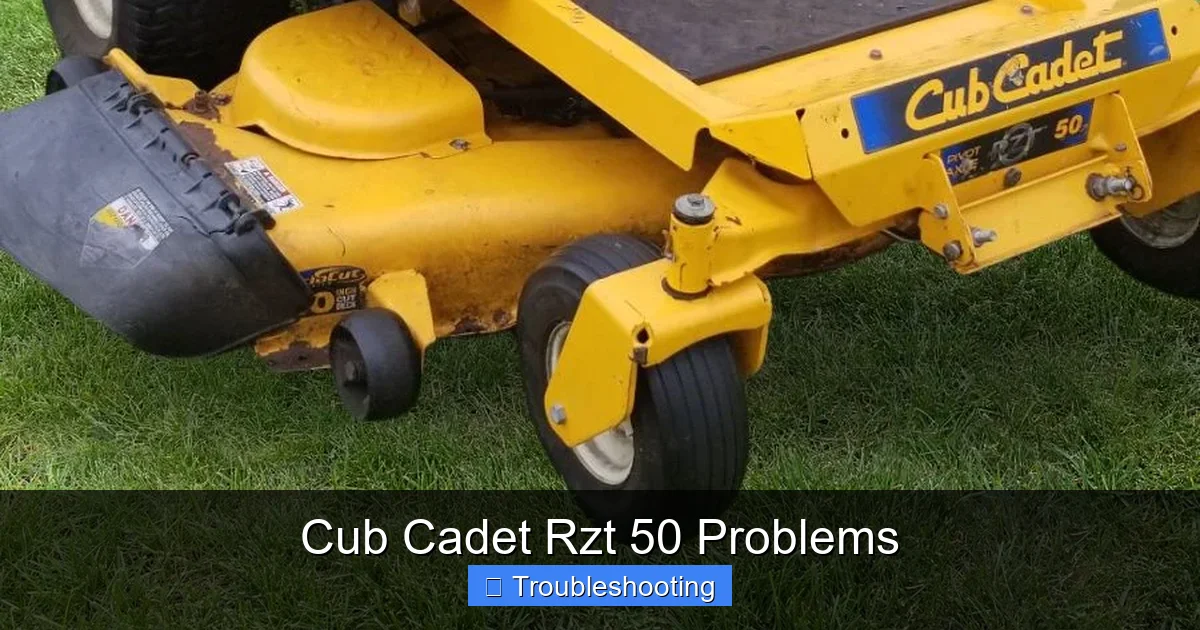
Visual guide about Cub Cadet Rzt 50 Problems
Image source: mowing.expert
The Wavy, Scalloped, or Uneven Cut
Your lawn looks like a series of hills and valleys after a pass. First, check your tire pressure. Uneven tire inflation causes the mower to sit crooked, leading to an uneven cut. All four tires should be inflated to the PSI listed in your manual (usually around 10-14 PSI). Next, deck leveling is critical. The deck must be parallel to the ground. Park on a flat surface, rotate each blade to point forward, and measure the distance from the blade tip to the ground at each corner. Adjust the deck lift links until all measurements are within 1/8″ of each other. A unlevel deck is a primary cause of poor cuts.
Now, inspect the blades themselves. Dull blades tear grass, creating a brown, ragged appearance. They must be sharpened or replaced. More importantly, check for blade balance. An unbalanced blade causes severe vibration and can damage the spindle bearings. Remove the blade, hang it on a nail or blade balancer. If one side drops, grind a little metal off the heavy side until it balances. Also, ensure blades are the correct length and not bent. A bent blade from hitting an obstacle will cause a horrific cut and intense vibration. Never try to straighten a bent blade; replace it immediately.
Severe Vibration and Loud Grinding Noises
This is a red flag. A vibrating deck that shakes the whole mower, often accompanied by a deep grinding or clunking noise, usually points to a failed spindle bearing or a broken blade drive belt. To diagnose, engage the blade clutch and listen. A high-pitched whine from a spindle area suggests a bearing is dying. A grinding sound indicates the bearing has failed completely, and the spindle shaft is now metal-on-metal. You must replace the spindle assembly. A rhythmic thumping or slapping could be a loose or broken blade. Immediately shut off the engine and inspect. A blade that has come partially loose or has a missing mounting bolt is extremely dangerous. Also, inspect the deck pulleys. A pulley with wobbly play or rough rotation has a bad bearing and must be replaced. Finally, a drive belt that is glazed, cracked, or has a section that is shredded will slip and cause vibration and a burning smell. Always replace the belt with an OEM-specified part of the exact length and width.
Transmission Troubles: The Hydrostatic Heart
The Cub Cadet RZT 50 uses a hydrostatic transmission (HST), essentially a hydraulic pump and motor system. This provides infinite speed control and instant direction change. Problems here can be complex but often have simple origins.
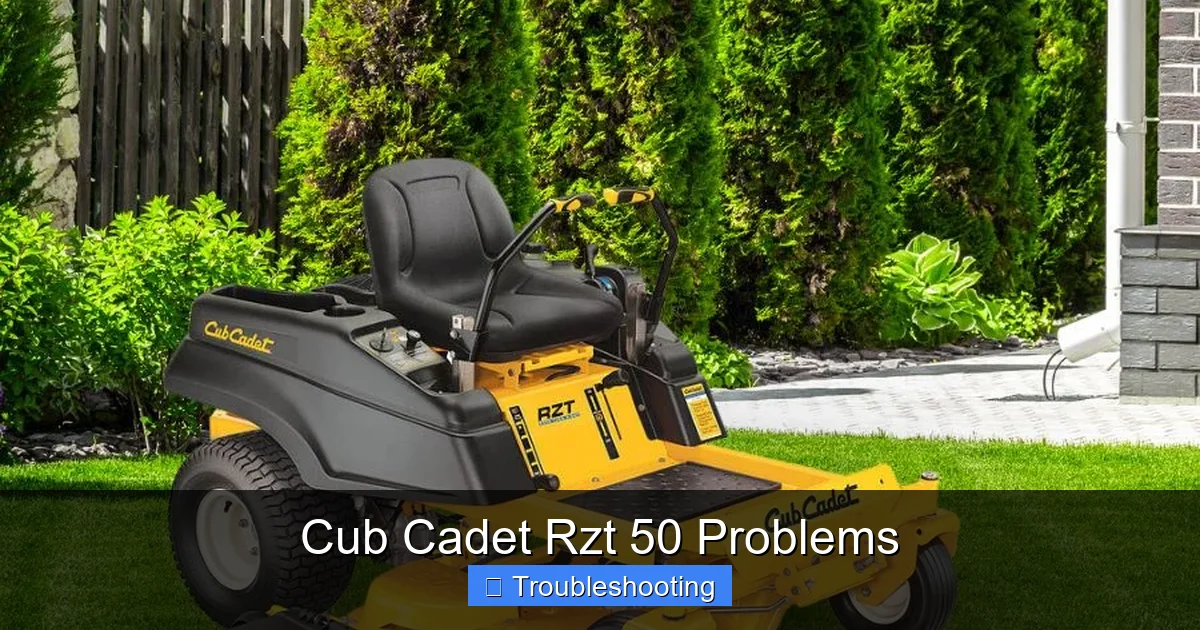
Visual guide about Cub Cadet Rzt 50 Problems
Image source: mowing.expert
Weak or Sluggish Response, “Creeping”
Your mower feels slow to accelerate, lacks its usual top-end speed, or slowly creeps forward/backward even with the control levers in neutral. The first check is transmission oil. The RZT 50 uses specific hydrostatic oil, usually a 20W-50 or a dedicated hydrostatic fluid (consult your manual). Low oil level is a direct cause of weak performance and internal damage. Check the dipstick (often located on the transmission itself) with the mower on level ground, engine warm, and control levers in neutral. Top up with the correct oil to the “Full” mark. If the oil is milky or smells burnt, it’s contaminated and must be drained and replaced—this is a sign of internal wear or a failed seal.
Next, inspect the drive belts and tensioners. The HST is driven by a belt from the engine. If this belt is loose, glazed, or worn, it will slip, causing a loss of power to the wheels. Check the belt for cracks and ensure the tensioner spring is intact and applying proper pressure. Also, check the neutral alignment. Over time, the linkage that sets the neutral position can become misadjusted. If the mover creeps in neutral, the control linkages to the transmission may need adjustment. This is detailed in your service manual and involves adjusting the length of the rods connecting the lever to the transmission.
Overheating and Transmission Whine
A high-pitched whine from the transmission area, especially under load, is a classic symptom of aeration or low fluid. Air in the hydraulic system causes cavitation, creating noise and heat. This often happens after an oil change if the system wasn’t properly purged. It can also occur from a minor leak that lets air in. The fix is a proper fluid change and purge procedure, which involves cycling the control levers forward and reverse with the engine running to force air out. Persistent whining, even with correct fluid, points to internal wear—worn pump or motor vanes. This is a major repair requiring a transmission rebuild or replacement. Also, ensure the cooling fins on the transmission housing are clean. Caked-on grass clippings act as insulation, preventing heat dissipation. Regularly blow out these fins with compressed air.
Electrical Enigmas: From Clutch to Charge
Modern mowers rely on electricity for starting, blade engagement, and charging. Electrical issues can be maddening but are often simple connections.
Electric PTO Clutch Won’t Engage
You pull the blade switch, hear a click, but the blades don’t spin. The electric clutch is a common failure point. First, verify the PTO switch itself isn’t faulty. You can test it for continuity with a multimeter. More frequently, the issue is a poor ground connection. The clutch grounds through the frame. A bolt with a green wire attached to the transmission housing or frame can become loose or corroded, breaking the circuit. Locate this ground point, remove the bolt, clean the contact surfaces and the ring terminal with a wire brush, and re-torque it securely. Next, check the fuse. The RZT 50 has a fuse for the PTO circuit in the wiring harness or under the dash. A blown fuse will kill the clutch. If the fuse blows immediately upon engagement, there’s a short in the clutch coil or wiring—the clutch itself may need replacement. Also, inspect the clutch coil for visible damage or burning smell. A failed coil is a replaceable part.
Battery Not Charging or Constantly Dying
The engine starts, but the battery drains after a few uses, or the lights are dim. First, test the battery itself with a multimeter. A fully charged battery should read 12.6 volts or higher. If it’s below 12.4 volts after charging, the battery is sulfated and failing. Next, check the charging system. With the engine running, the voltage at the battery terminals should be 13.5-14.5 volts. If it’s only 12 volts or less, the stator (alternator) is not producing power. The stator is a coil of wire under the engine flywheel. It can fail due to heat or vibration. Testing it requires checking resistance values per your manual. Also, inspect the rectifier/regulator (if equipped). This component converts AC from the stator to DC and regulates voltage. A failed regulator can either under-charge or over-charge (cooking the battery). Finally, check for parasitic drain. Something is drawing power when the key is off. Pull the negative battery cable and use a multimeter in amps mode between the cable and terminal. A reading above 0.05 amps indicates a drain. Unplug accessory fuses one by one to isolate the circuit.
Steering and Mobility: Handling and Maneuverability
Zero-turn steering is precise. When it becomes sloppy, stiff, or pulls to one side, it’s a safety and usability issue.
Loose or Sloppy Steering
You feel excessive play in the steering levers, and the mower’s direction changes are not crisp. The root cause is almost always worn or loose steering linkage components. The system consists of the lever, a series of rods and bushings, and the wheel hub assembly (or “pivot point”) on each rear wheel. Start by inspecting the tie rod ends and bushings. These are the small ball joints connecting the rods. If they have play or the rubber bushings are cracked, they must be replaced. Also, check the steering lever pivot points on the frame. These have bushings or bearings that wear out. A wobbly lever at its mount indicates a failed bushing. Finally, the wheel hub bearings themselves can wear. Jack up the rear of the mower, grab the wheel at 12 and 6 o’clock, and try to wiggle it. Any noticeable play means the hub bearing is bad and needs replacement. This is a critical safety item—a failed hub can cause a wheel to lock or fall off.
Mower Pulls to One Side
Even with the levers centered, the mower drifts left or right. This can be a tire pressure issue (check and equalize all tires). It can also be a deck pitch issue (if the deck is unlevel, it can create a pulling force). However, the most common cause is uneven transmission bypass valve settings. The RZT 50 has a bypass valve (or “freewheel valve”) on each transmission for pushing the mower manually. If one bypass valve is slightly more open than the other, that side will have less resistance and cause a pull. These valves are small, threaded plugs. Consult your manual for the exact location and procedure to adjust them to an equal, closed position. Another possibility is a weak or failing transmission on one side. If one trans is lower on fluid or has internal wear, it will produce less power, causing a pull. Diagnose by driving on a flat surface with the deck disengaged; if the pull persists, it’s a transmission/steering issue, not a deck issue.
Conclusion: Empowered Ownership Through Knowledge
Facing Cub Cadet RZT 50 problems doesn’t have to mean a trip to the dealer and a hefty bill. As we’ve explored, the majority of issues—from a sputtering engine to a vibrating deck—stem from predictable wear points and routine maintenance oversights. The key is becoming a proactive diagnostician. Start with the simplest, most accessible checks: fuel quality, air filter cleanliness, belt condition, and bolt tightness. Your mower’s service manual is your most valuable tool; it contains the specific torque specs, fluid types, and adjustment procedures for your exact model year. By understanding the common failure points outlined here—the fuel system’s hatred of ethanol, the deck’s dependence on sharp, balanced blades, the hydrostatic transmission’s thirst for the right oil—you transform from a frustrated owner into a capable caretaker. Remember, there’s a profound satisfaction in hearing your RZT 50 roar to life and cut a perfect stripe after you’ve solved the problem yourself. Equip yourself with the right parts, follow the safety protocols (always disconnect the spark plug before working!), and don’t hesitate to consult online forums or videos for your specific model. Your lawn—and your wallet—will thank you.
Frequently Asked Questions
Why does my Cub Cadet RZT 50 backfire through the carburetor?
Backfiring is usually caused by a lean fuel mixture or a timing issue. First, check for air leaks in the intake manifold gasket or carburetor base. A cracked or loose hose can allow unmetered air in. Also, a weak spark from an old or faulty spark plug/coil can cause unburned fuel to ignite in the intake. Finally, if the engine was recently worked on, the valve clearance may be incorrect, altering timing. Start with the plug and air filter, then inspect intake seals.
My RZT 50 deck is leaving clumps of grass. Is it a blade issue?
While dull blades contribute, clumping is more often a deck pitch and airflow problem. If the deck is set too low, grass is cut but can’t exit the deck quickly, clumping under wet conditions. Ensure the deck is level and set at the proper height for your grass type. Also, check the deck baffles and discharge chute for damage or clogging. A blocked chute will prevent grass from ejecting. Finally, mow when grass is dry; wet grass will clump on any mower.
What causes a loud squealing noise from the engine area?
A high-pitched squeal that changes with engine RPM is almost always a slipping belt. Check the engine drive belt that turns the mower deck and the PTO clutch belt. The belt may be loose, worn, glazed, or the tensioner pulley bearing may be seized, preventing proper tension. Inspect all pulleys for smooth rotation and ensure tensioner springs are intact and functional. Replace any glazed or cracked belts immediately.
How do I know if my hydrostatic transmission oil is bad?
Look for these signs: the oil is dark brown or black (it should be a clear amber or red, depending on type), it has a burnt smell, or it appears milky/foamy (indicating water contamination). Also, if you notice a significant drop in performance (sluggish movement, overheating) and the oil level is correct, the fluid is likely degraded and must be changed. Use only the oil specified in your manual, typically a 20W-50 motor oil or a dedicated hydrostatic fluid.
Can I use regular motor oil in my RZT 50’s engine and transmission?
For the engine: Yes, use a high-quality detergent oil rated SAE 10W-30 or 5W-30 for most temperatures. For severe heat, 10W-40 may be acceptable. Never use 2-cycle oil. For the hydrostatic transmission: This is critical. Many RZT 50 models require 20W-50 motor oil, but some later models specify a dedicated hydrostatic fluid like Cub Cadet Hydro-Max or a specific brand of ISO 46 hydraulic oil. Using the wrong oil can cause catastrophic transmission failure. Always check your owner’s manual for the exact specification.
What’s the single most important thing I can do to prevent Cub Cadet RZT 50 problems?
Adhere to a rigorous seasonal maintenance schedule. This means: 1) Change the engine oil and filter after every 50 hours of use or annually. 2) Replace the fuel filter and air filter at least once a year, more often in dusty conditions. 3) Use fresh, stabilized fuel and never let the mower sit with untreated fuel for more than 30 days. 4) Clean the deck top and bottom after every few mows to prevent rust and clogging. 5) Sharpen and balance blades at least twice a season. 6) Check and adjust tire pressure and deck level monthly. This disciplined approach addresses the root causes of over 80% of common failures.