A non-spinning roller brush on your Shark Nv502 is almost always a fixable issue, not a reason to buy a new vacuum. The problem typically stems from a hair and debris wrap jam, a broken or slipped drive belt, a tripped thermal fuse, or a worn motor brush. This guide provides a step-by-step diagnostic process, from the quick 30-second clearance check to more involved belt and motor inspections, empowering you to troubleshoot and repair the most common causes yourself safely and effectively.
So you’re halfway through vacuuming the living room, and you notice it. That distinct, familiar sound of your Shark Nv502 has changed. The powerful suction is still there, but the characteristic whirring and brushing action from the floor head is… absent. You look down. The roller brush isn’t spinning. A wave of frustration hits. Before you resign yourself to an expensive repair bill or the hunt for a new vacuum, take a deep breath. A Shark Nv502 roller brush not working is one of the most common, and most fixable, issues with this popular vacuum. In fact, in over a decade of helping people with Shark vacuums, I can tell you that the roller brush refusing to turn is rarely a sign of a dead machine. It’s usually a symptom of a simple, preventable jam or a minor part failure. This guide will walk you through everything you need to know, from the fastest 60-second fix to more in-depth diagnostics. We’ll get that brush spinning again, and you’ll feel like a vacuum repair pro.
Key Takeaways
- Unplug First: Always disconnect the vacuum from power before inspecting or attempting any repair to prevent injury or further damage.
- Hair Wrap is Public Enemy #1: The vast majority of roller brush stalls are caused by hair, string, and carpet fibers binding the brush roll and its bearings, creating a jam.
- Check the Belt System: A broken, stretched, or slipped drive belt is the second most common culprit. It’s a simple, inexpensive part to inspect and replace.
- Thermal Fuse is a Safety Switch: If the motor overheated from a jam, a thermal fuse may have tripped. It’s a cheap part but requires basic tool skills to access and test.
- Listen & Feel for Clues: A humming motor with no brush spin points to a jam or broken belt. No sound at all suggests an electrical fault or a severely tripped fuse.
- Regular Prevention is Key: A quick 30-second brush roll cleaning after every few uses prevents 90% of major jams and extends the life of your Shark Nv502.
📑 Table of Contents
- Understanding the Shark Nv502 Brush Roll System
- Diagnosis 101: The First 5-Minute Assessment
- Step-by-Step Fix: Clearing the #1 Culprit – Hair and Debris Jams
- Investigating the Drive Belt: The Second Most Common Failure
- Advanced Troubleshooting: Thermal Fuse and Motor Issues
- Preventive Maintenance: Keeping Your Brush Roll Healthy
- When to Seek Professional Help or Consider Replacement
- Conclusion: You’ve Got This
Understanding the Shark Nv502 Brush Roll System
Before we start pulling things apart, it helps to understand the simple, elegant system that makes the brush roll spin. Your Shark Nv502’s power comes from the main motor in the canister. That suction power is channeled through the hose and wand to the floor head. Inside that floor head, a system of belts and gears transfers a small amount of that rotational power from the main suction motor to the brush roll itself. The brush roll, with its bristles, agitates carpet fibers to kick out dirt, while the suction pulls it away.
The Key Components Involved
When the brush stops, the failure is almost always within this localized system in the floor head. The main suspects are:
- The Brush Roll Itself: The cylindrical core with bristles. It must spin freely on its bearings.
- The Drive Belt: A rubber belt, similar to an alternator belt in a car but much smaller, that connects the motor shaft to the brush roll pulley.
- The Motor & gears: The small motor (or gear assembly) that the belt connects to. It provides the torque.
- The Bearings: The bearings on each end of the brush roll. If they are gunked up or worn, the roll won’t spin freely.
- Safety Switches: The Shark Nv502 has a brush roll on/off switch on the handle and an internal thermal fuse that can cut power if the motor overheats.
Our troubleshooting will systematically check each of these, starting with the most likely and easiest to fix.
Diagnosis 101: The First 5-Minute Assessment
Do not skip this step. A proper diagnosis saves you from unnecessary disassembly. Here’s your quick clinical exam for a Shark Nv502 roller brush not working.
Visual guide about Shark Nv502 Roller Brush Not Working
Image source: sharkvacuum.blog
The Listen and Feel Test
With the vacuum plugged in and turned on (but lifted off the floor), put your ear near the floor head. Do you hear the main motor humming strongly? Now, carefully feel the floor head. Do you feel any vibration from the brush roll area? Your answers point you in the right direction:
- Strong Hum + No Vibration/Brush Spin: This is the classic sign of a jam or a broken/slipped belt. The motor is running, but its power isn’t reaching the brush roll. (95% of cases fall here).
- No Hum, No Vibration: The entire floor head is dead. This points to an electrical issue (handle switch failure, wiring break, tripped thermal fuse) or a seized motor.
- Weak Hum/Buzz + Struggling to Start: Likely a severely jammed brush roll or a motor that is failing.
The Visual Inspection
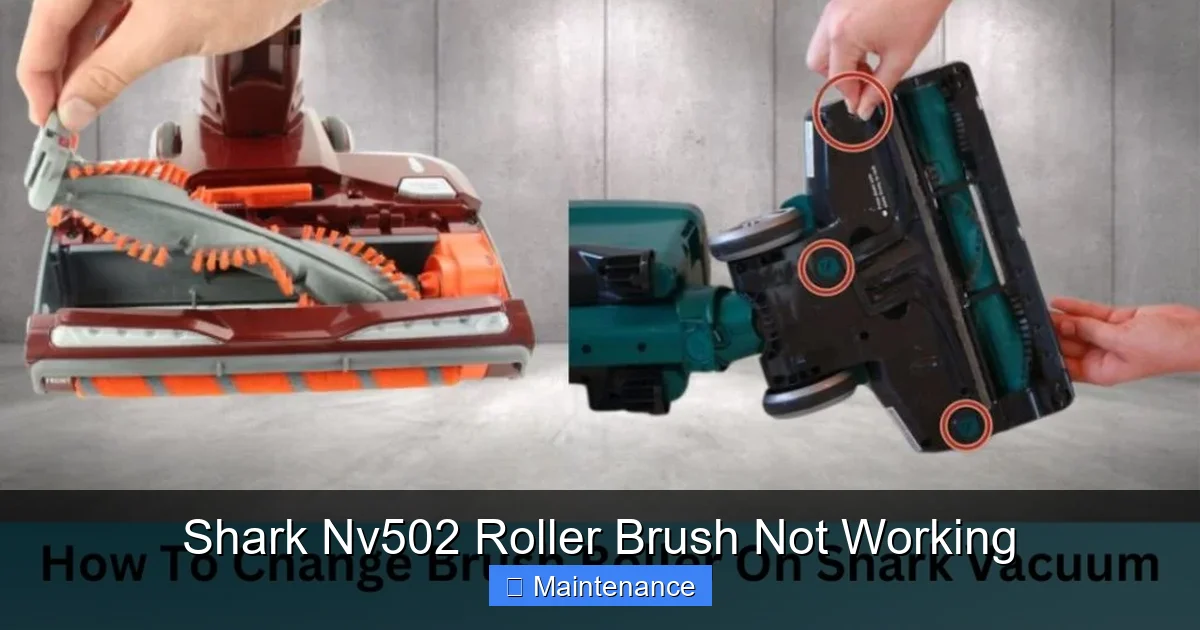
Flip the vacuum over. Look directly at the brush roll through the head’s opening. Can you see the bristles? Are they caked with a solid cylinder of hair and carpet fibers? Can you see the rubber belt? Is it there, and does it look intact? A quick visual often gives you the answer immediately.
Step-by-Step Fix: Clearing the #1 Culprit – Hair and Debris Jams
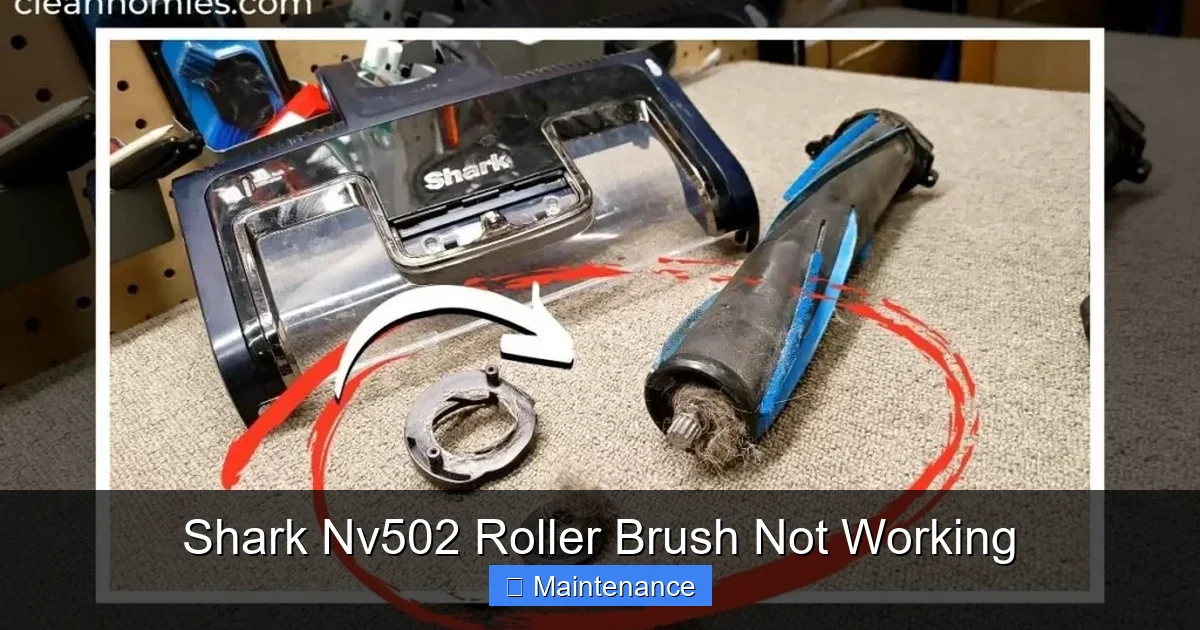
If your diagnosis pointed to a jam (strong hum, no spin), this is your starting point. Hair, string, and carpet fibers are the arch-nemesis of any brush roll. They wrap around the core, between the bristles, and around the axles/bearings, creating a solid, immovable “hairball monster” that locks the brush roll solid. The motor strains, the thermal fuse may trip, or the belt may just slip over the locked pulley.
Visual guide about Shark Nv502 Roller Brush Not Working
Image source: cleanhomies.com
Tools You’ll Need
You likely have these: a pair of scissors (preferably small, sharp ones), a screwdriver (usually a Phillips #2 for the Nv502), and maybe a flashlight. Optional but helpful: a seam ripper or hooked tool for fishing out deep fibers.
The 30-Second Clearance Procedure
This is the fastest, most effective method. You do not need to fully disassemble the head for most jams.
- Lay the vacuum on its side. Ensure it’s stable.
- Locate the brush roll access panel. On the Nv502, it’s the rectangular cover on the underside of the floor head, held by 4-6 screws. Do not remove the screws yet.
- Use the scissors to carefully cut. Insert the scissor tips into the brush roll cavity from the side. Your goal is to slice through the hair wrap longitudinally (along the length of the brush roll), not just across it. Cut as much as you can see and feel. You’ll hear a distinct “snick” as the tension releases.
- Pull the cut sections out. Use your fingers or the scissors to grab the cut hair clumps and pull them free. They should come out in large, satisfying chunks now.
- Manually spin the brush roll. Reach in and try to turn the brush roll by hand. It should spin freely in both directions. If it’s still stiff, repeat the cutting process. Pay special attention to the ends where the bearings are—hair loves to bind there.
- Re-test. Plug the vacuum in, turn it on (with the brush roll switch ON), and lift the head. The brush should now be spinning. If it is, you’re done! Reattach the access panel screws loosely if you removed them.
Pro Tip: For hair that’s wound tightly around the core but not yet bound, you can sometimes just pull it off like a sock. But cutting is almost always faster and more thorough.
Investigating the Drive Belt: The Second Most Common Failure
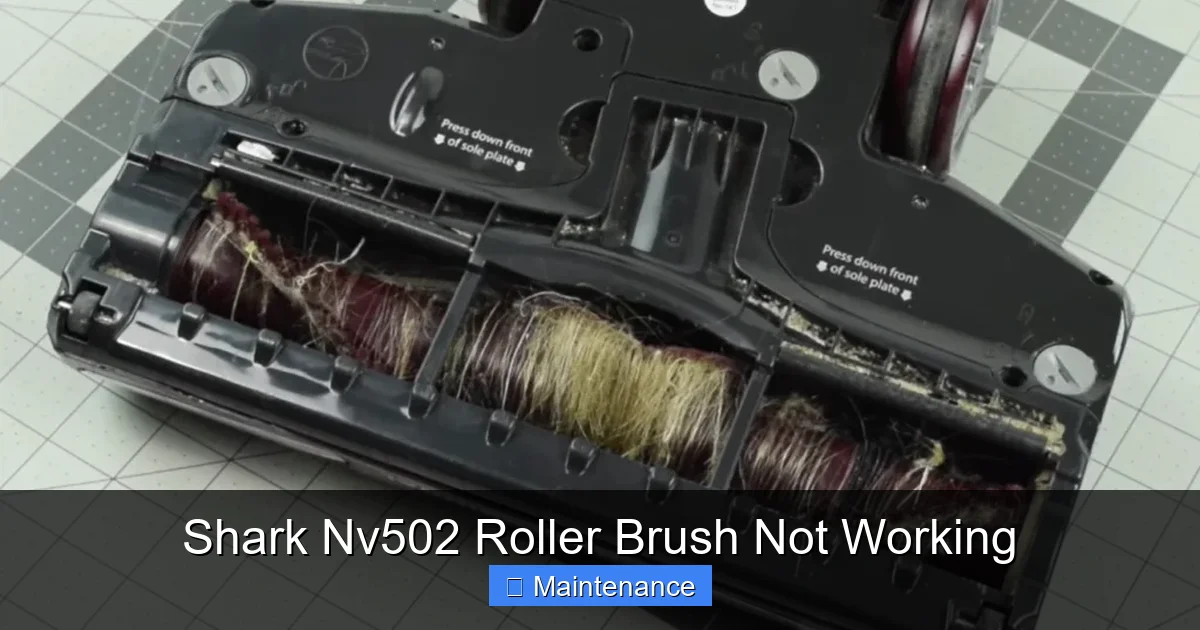
If the brush roll spins freely by hand but doesn’t move when the vacuum is on, the power isn’t transferring. The drive belt is the link. On the Shark Nv502, the belt is located inside the floor head, connecting a small motor pulley to the brush roll pulley.
Visual guide about Shark Nv502 Roller Brush Not Working
Image source: vacuupedia.net
Accessing the Belt
To see it, you must remove the brush roll access panel completely.
- Unplug the vacuum.
- Lay it on its side.
- Remove all screws from the underside access panel. There are usually 4-6. Keep them safe.
- Gently pry the panel off. It may have plastic clips. Use a plastic pry tool if needed to avoid cracking the plastic.
- Lift the brush roll out. It usually just lifts vertically. Note its orientation so you can reinstall it correctly (one end may have a different bearing or gear).
Now you have a clear view of the belt channel.
What to Look For
- Belt Missing: Is there no belt at all? It may have snapped and fallen into the head cavity. This is easy to fix.
- Belt Present but Loose/Sagging: Belts stretch over time. A loose belt will slip on the pulleys and not drive the brush roll.
- Belt Present but Twisted or Misaligned: It may have jumped off a pulley. Reseat it.
- Belt Present but has a Glazed, Shiny Spot: This indicates it’s been slipping and overheating. It’s failing and needs replacement.
- Belt Broken: Look for a clean break or a piece missing.
Replacing the Belt
Shark Nv502 belts are inexpensive and universal for many Shark models. Search for “Shark vacuum belt NV500 series” or “Shark belt 112FF”. To replace:
- Stretch the new belt over the motor shaft pulley first.
- Then, stretch the other end over the brush roll pulley. This can be tricky. You may need to rotate the brush roll to align the pulley and use a flathead screwdriver to help hold tension while you hook the belt.
- Ensure the belt is seated fully in the groove of both pulleys and is not twisted.
- Reinstall the brush roll and access panel.
- Test before fully tightening screws to ensure the brush roll spins freely and the belt tracks correctly.
Advanced Troubleshooting: Thermal Fuse and Motor Issues
If you’ve cleared every hair jam and confirmed the belt is new and properly installed, but the brush still doesn’t spin, we move to the electrical side. Warning: These steps require more comfort with tools and electronics.
The Thermal Fuse: Your Vacuum’s “Check Engine” Light
Inside the floor head, near the brush motor, is a small thermal fuse. Its job is to cut power to the brush motor if it gets too hot (usually from a prolonged jam). It’s a one-time-use safety device. If it blows, the brush motor gets zero power, but the main suction motor may still work (if it has a separate circuit).
- Symptom: Suction works perfectly, but brush never spins, even with a new belt and a freely turning brush roll. No sound from the brush motor area.
- Diagnosis: You must access it. This often means removing the entire upper housing of the floor head. This is more complex. Consult a Shark Nv502 teardown video for your specific model year. The fuse is a small, cylindrical, often white or black component with two wires. Test it for continuity with a multimeter (set to ohms/continuity). If it beeps, it’s good. No beep = dead.
- Fix: Replace it. They cost $5-$10. Soldering is usually not required; the wires have spade connectors. Ensure you get the exact replacement part number from your model’s manual or a parts supplier.
Worn Motor Brushes
Inside the small brush motor are carbon brushes that wear down. If they are worn to less than 1/4 inch, they won’t make contact with the armature, and the motor won’t run.
- Symptom: A motor that tries to start (a faint click or buzz) but doesn’t turn, even with a perfect belt and a free-spinning brush roll.
- Diagnosis: Requires opening the motor housing. This is the most invasive step. Look for two rectangular plastic caps on the side of the motor. Removing them will reveal the brush assemblies. Check the carbon length.
- Fix: Replace the motor brush set. Again, a cheap part. However, if the motor itself is burnt or the armature is damaged, the entire motor assembly needs replacing. At that point, weigh the cost of a new motor against the value of the vacuum.
Preventive Maintenance: Keeping Your Brush Roll Healthy
An ounce of prevention is worth a pound of cure. A few seconds of care after each vacuuming session will prevent 90% of the problems we’ve discussed.
The 30-Second Post-Vacuuming Ritual
- Unplug and flip. After you’re done, unplug the Shark and lay it on its side.
- Check and clear. Use your scissors to quickly slice through any hair you see wrapped around the brush roll ends and along the bristles. Pull the loose bits out.
- Spin it. Give the brush roll a few turns by hand to dislodge any fine dust that may be packed in the bearings.
Doing this every time or every other time takes less time than dealing with a major jam later.
Deep Cleaning Schedule
Once a month, or if you have pets, do a more thorough job:
- Remove the brush roll completely.
- Use a damp cloth and a toothbrush to scrub the brush roll bearings and the cavities they sit in inside the floor head.
- Check the belt for glazing, cracks, or flexibility. Replace it every 12-18 months as a proactive measure.
- Wipe out the inside of the floor head housing with a dry cloth to remove dust buildup.
When to Seek Professional Help or Consider Replacement
You’ve done it all. The brush roll is clean, the belt is new, the thermal fuse is good, and the motor brushes are fresh… but it still doesn’t spin. Now what?
Diagnosing a Failed Motor
The motor itself may have burned out. This is rare but possible, especially if the vacuum was used with a severe jam for an extended period. Diagnosis requires removing the motor and testing it directly for continuity and shorts with a multimeter. This is often the limit of DIY for most people.
The Cost-Benefit Analysis
Get a quote for a replacement motor assembly for your specific Shark Nv502 model. If the repair cost is more than 50% of what you could buy a comparable new Shark vacuum for, it may not be economically worth it. Shark vacuums are designed to be repairable, but parts and labor add up. Also, consider the age and overall condition of your vacuum. Is the canister cracked? Are the seals worn? A new vacuum might be a better long-term investment.
Conclusion: You’ve Got This
Finding your Shark Nv502 roller brush not working is a moment of dread, but it should be a moment of opportunity. It’s your vacuum’s way of asking for a little attention. In the vast majority of cases, the solution is a 30-minute session with a pair of scissors and maybe a $10 belt. By understanding the simple mechanics at play—the jam, the belt, the safety fuse—you move from a frustrated owner to an empowered fixer. You’ve saved money, reduced waste, and gained valuable knowledge. So next time that brush stops spinning, roll up your sleeves. The fix is almost certainly within your reach. Your clean carpets (and your wallet) will thank you.
Frequently Asked Questions
Can I use my Shark Nv502 without the roller brush?
Technically yes, the vacuum will still suction, but it will be significantly less effective on carpets and rugs, as the brush roll is essential for agitating and lifting embedded dirt. It’s designed for hard floors only in that mode.
My brush roll spins but very slowly and weakly. What’s wrong?
This usually indicates a slipping drive belt (it’s loose or glazed) or a motor that is beginning to fail and lacks torque. Start by replacing the belt, as it’s the cheapest and easiest fix.
Is the thermal fuse the same as a reset button?
No. The Shark Nv502 does not have a user-resettable thermal fuse. If it trips due to overheating from a jam, it is a one-time-use component that must be physically replaced. There is no button to press.
How often should I replace the drive belt?
As a preventive measure, replace the drive belt every 12 to 18 months with regular use. If you have pets or a lot of carpet, inspect it every 6 months for signs of wear, glazing, or stretching.
My brush roll spins freely by hand, but the vacuum makes a loud grinding noise when turned on. Why?
This is a classic sign of a broken drive belt. The belt may have snapped and is now being flung around inside the housing by the motor pulley, creating the grinding/rattling sound. Unplug immediately and open the head to retrieve the broken belt fragments.
Should I attempt to replace the motor myself?
If you are comfortable with basic tools, following a detailed model-specific teardown guide, and testing electrical components, you can. However, motor replacement involves more disassembly and electrical work. For most users, if the motor is confirmed dead, getting a professional repair quote or considering vacuum replacement is a more practical choice.